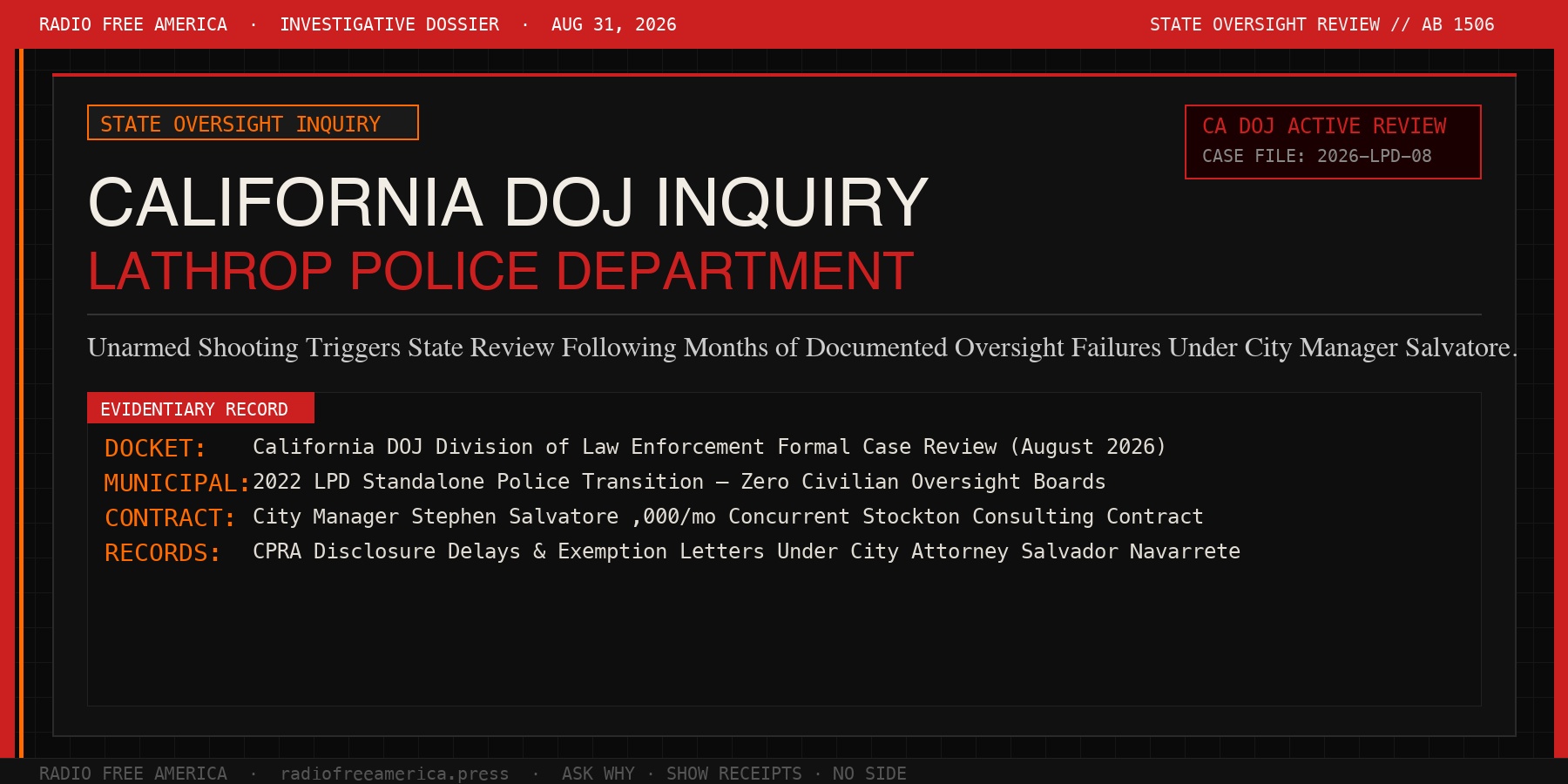
Source: California Department of Justice, Division of Law Enforcement / City of Lathrop Records — August 2026
California DOJ Opens Inquiry Into Lathrop Police Shooting of Unarmed Civilian: State Scrutiny Follows Pattern of Municipal Secrecy Under City Manager Stephen Salvatore
When an officer with the newly independent Lathrop Police Department shot an unarmed subject, city leadership maintained internal reviews were sufficient and tightly managed the release of public records. Now, the California Department of Justice has opened a formal inquiry into the incident — bringing state law enforcement scrutiny to a municipal administration with no independent civilian police oversight and a documented pattern of administrative resistance.
The state review follows months of investigative reporting by sister publication Dismal Freedom Press (DFP) documenting governance failures under Lathrop City Manager Stephen Salvatore. Those records reveal a systemic absence of checks: the 2022 transition from County Sheriff contracting to an independent police department was executed without establishing a civilian review board; public safety tax oversight committees were blocked by council leadership from examining police practices; public records requests were funneled exclusively through Salvatore and City Attorney Salvador Navarrete; and Salvatore concurrently collected approximately ,000 per month in outside consulting fees from the City of Stockton until public exposure forced the contract's termination.
Radio Free America connects the primary documents: the state DOJ notification, City Council closed session records, and CPRA disclosure logs to ask the question municipal leadership avoided: why was there no independent oversight before the state stepped in?
Read the Full Investigation & ReceiptsPublic Safety Requires Public Accountability. Not Administrative Walls.
When a police department deploys lethal force against an unarmed resident, the credibility of local government hinges entirely on transparency, independent fact-finding, and an uncompromised chain of oversight.
In Lathrop, public records show that the municipal infrastructure built over the past four years achieved the opposite: centralized control in the City Manager’s office, zero independent civilian police oversight, and an administrative posture that treated public inquiries and public records requests as hostile interventions rather than legal obligations.
The California Department of Justice inquiry did not happen in a vacuum. It is the direct consequence of what happens when local governance creates an echo chamber where internal staff evaluate internal conduct, council committees are barred from oversight, and leadership prioritizes administrative self-protection over public accountability. Radio Free America will continue to pull the documents, verify the timelines, and publish the receipts.
City of Lathrop Police Department Transition Resolution & Municipal Service Review (2022)
Measure C Sales Tax Oversight Committee Agendas & City Council referral declination minutes
City of Stockton / City of Lathrop Concurrent Consulting Agreement & Severance Records (,000/mo)
City of Lathrop CPRA Tracking Log & Exemption Determination Letters (2025–2026)
California AB 2624 Enrolled Bill Text & Final Legislative Roll Call Votes (Assembly 52-16, Senate 29-8 — August 2026)
Every investigation starts with the same question. Not who, not where — why. Why did this happen? Why was oversight bypassed? Why does the public record contradict the official statement? That question, asked from neutral ground with primary sources, is where accountability begins.
Latest Investigations
Full archive →The Lathrop Oversight Vacuum: How an Unarmed Shooting Triggered State DOJ Review
From the 2022 sheriff separation to the August 2026 DOJ inquiry: the primary source record of how municipal checks were bypassed under City Manager Stephen Salvatore.
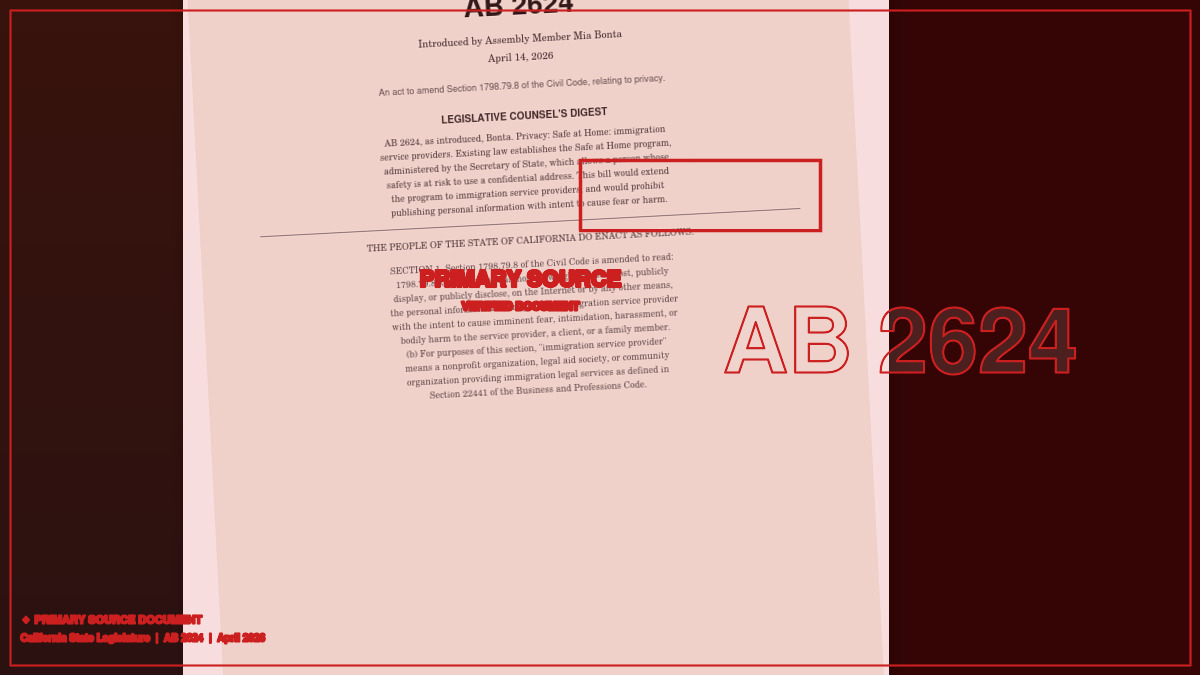
AB 2624 Heads to Governor's Desk: The Final Bill Text, the Lobbying, and the Record
As California's 2026 legislative session concludes, we examine the final enrolled language protecting service workers from targeted doxing while preserving public records rights.
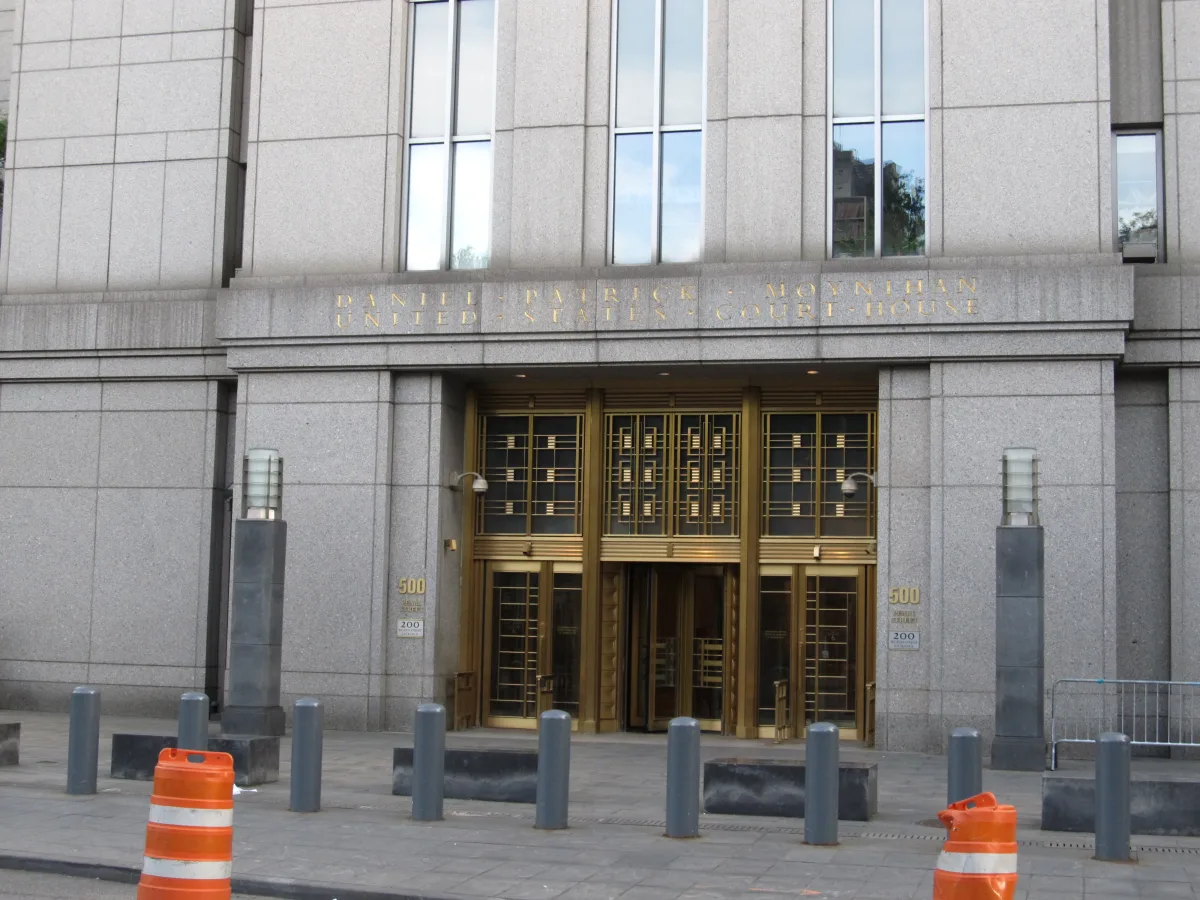
Consent Decrees and Accountability: Live Nation's Remedy Phase Enters Fall 2026
The post-verdict structural remedies under federal court supervision: what venue records reveal about ongoing bundling and promoter exclusivity.
FreeWire — RFA Original Reporting & Wire Feed
Full wire →23:15 RFA Wire
15:40 RFA Wire
10:20 RFA Wire
14:10 RFA Wire
Why Radio Free America Exists
The line between accountability journalism and institutional PR has never been thinner. Government entities issue curated statements and label citizen inquiries as harassment. Influencers publish personal addresses and label doxing as reporting. Outlets dependent on institutional access sacrifice hard questions to preserve their standing.
Radio Free America operates on neutral ground: we follow the primary source, pull the public records, verify the timestamps, and show the receipts. We ask why — without fear, without favor, and without institutional capture.
Radio Free America is an independent national publication of Rooted Creative Group LLC. We do not accept funding from the institutions, agencies, or entities we investigate. That independence is structural.
"Asking why, from neutral ground, with primary sources — that is not an opinion. That is the job. It barely exists anymore. So we are doing it ourselves."Radio Free America — Editorial Charter, 2026
Direct newsroom tips: tips@radiofreeamerica.press